
Country Kenya
Duncan’s Chaff Cutter: 10 t/h, Diesel, and Already Cutting
Duncan of Kiko Feeds in Kisii came back to LUCTORC for a second machine — a 10 t/h diesel chaff cutter. This time the footage is of it working, not travelling.
More articles
-
 Charles’s 3.8T Chaff Cutter: From an Office Visit to On Its Way to Kenya16 October 2026 · Customer Stories · Kenya
-
 A Son’s Gift: A 5.8 t/h Chaff Cutter for His Father’s Farm in China15 October 2026 · Customer Stories · China
-
 From Crate to Wrapped Bale: A Kiambu Farm Delivery Day6 October 2026 · Customer Stories · Kenya
Get a quotation
Tell us what you process, your daily volume and the power at your site. We reply with a suitable machine, its specification and a quotation.
索取报价 WhatsApp 联系我们 2000 Plaza, Mombasa Road, Nairobi
Monday to Friday, 10am to 5pm
In September we published Duncan’s first LUCTORC machine — a silage baler wrapper, followed from its factory test in China to the day it was unpacked in Nairobi. He has since added a second machine to Kiko Feeds: a 10 t/h diesel chaff cutter. This time the footage is not of a machine travelling. It is of a machine working.
That difference is the point of this story. A delivery photograph proves a machine arrived. A running machine, fed with the material actually standing on the site, proves something more useful to anyone weighing up the same purchase.
The machine that came after the baler
Kiko Feeds trades from Kikoville Pavilion in Kisii Town, selling hay, molasses, cottonseed cake, rice germ and mineral salt blocks. Duncan’s first LUCTORC purchase was a silage baler wrapper; that story is still online as Duncan’s Baler: From Factory Test to Kenya.
A chaff cutter does the job that sits in front of a baler, and in front of a feed trough. It takes long material — maize stover, cane tops, grass, straw — and cuts it into short, even lengths. Short material packs tighter, ferments more reliably when it is ensiled, and is far easier for stock to eat without sorting and wasting the stalks. The 10 t/h rating is the largest of the plain diesel and electric ratings LUCTORC lists before the heavier 9Z series begins.
We have not asked Duncan to explain his reasoning and are not going to invent it. What the record shows is a customer who bought one machine, saw it through, and came back for a second.


Tagged with his name before it left
Every unit LUCTORC photographs for a customer carries a paper tag with the destination and the buyer written on it, and the tag stays with the machine through assembly, testing and crating. It is a small habit that does a lot of work: it is how we can show a customer their own machine rather than a stock photograph of the model.
The two photographs show the parts that matter on this build. The long slatted infeed conveyor is what lets one person keep a 10 t/h machine fed without standing over the blades. The engine is a single-cylinder diesel on its own castored skid, belt-driven to the cutter, with a starter motor fitted — so the machine carries its own power and does not depend on a three-phase supply at the site.
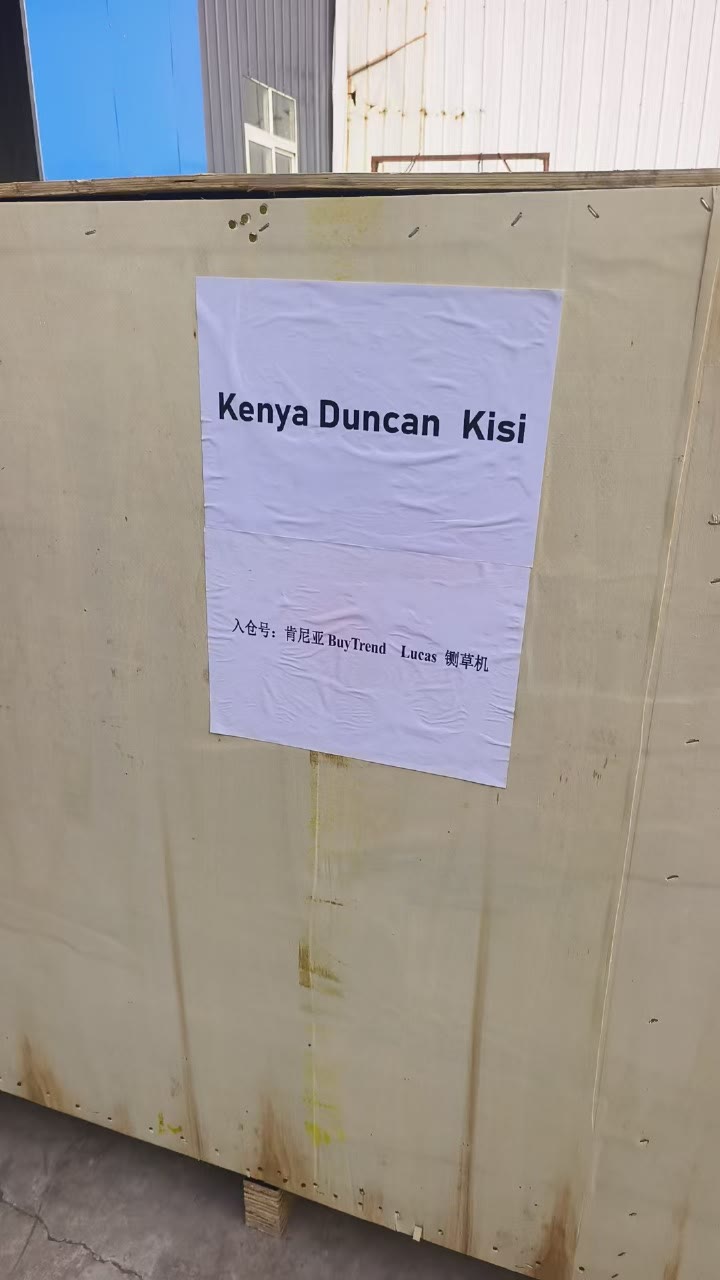
Crated for Kenya
The machine was then closed into a timber crate and labelled for Kenya. Duncan’s baler made the same trip and was photographed being opened in a Nairobi yard; this crate’s own arrival was not filmed, so we are not going to describe it.
What we can show is the next time the machine appears on camera — out of the crate, on the ground, and running.

What the video actually shows
The clip runs for forty-four seconds and is unedited apart from our own caption. An operator in a hard hat stands at the far end of the infeed conveyor and feeds whole maize stalks onto it, leaves and all. The engine runs at a steady note throughout. Chopped material leaves the machine in a continuous jet and lands as a growing heap against the wall of the compound.
Around the machine, the ground tells the rest of the story: a wide mat of already-cut material on one side, and a bank of uncut green stalks waiting on the other. The machine is not being demonstrated on a clean sample. It is part-way through a real pile.
10 t/h is the factory’s rating for this machine, not a figure measured at Duncan’s site. No one timed this session, weighed the output or recorded how long a tank of fuel lasts, so none of that is claimed here. What the video documents is the machine running under load on the customer’s own material.
The next useful update
The figures a buyer really wants are the ones only Duncan can supply: how much he gets through in an ordinary working day, how the cut length suits the stock he is feeding, and how the diesel engine holds up over a season. If he sends them, they will be added here — and not before.
Discuss your own cutting
Tell LUCTORC what you need to cut, roughly how much of it per day, and what power you have at the site — mains, three-phase, a tractor, or nothing at all. That is usually enough to point you at the right rating rather than the biggest one. See the 10 t/h chaff cutter, the full chaff cutter range from 3.8 to 15 t/h, or contact LUCTORC.
See the chaff cutter range